
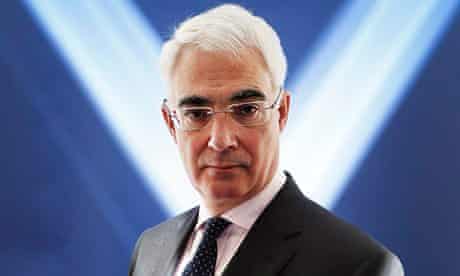
LONDON (Dow Jones)– It’s easy to put all the blame on U.K. Chancellor Alistair Darling for the current fate of Northern Rock.
But all he’s done is protect the largest capital provider to the bank – British citizens. If blame targets are what one’s looking for now, topping the list are the private parties led by Richard Branson’s Virgin group and other potential buyers who underestimated Darling’s ability to call their bluff.
Still, Darling is partially at fault for prolonging the uncertainty; after all, the run on Northern Rock happened in mid-September. But then, who had expected the severity of the credit crisis to be so prolonged? Many of the world’s top banks are still writing down their assets.
And the Rock’s success or failure is closely linked, unfortunately, with how global credit markets perform. Especially so at Northern Rock, where only 30% of the bank’s source of funds are depositors with the rest coming from wholesale funding markets.
Darling also made a mistake in naming the Virgin-led consortium as preferred buyer very early on in the bidding process, long before the government got its own economics on the deal right.
The government’s priorities don’t include profiteering from private sector deals but it also cannot use the tax payer’s mandate to guarantee loans without claiming a monetary return for doing so. Remember, a guarantee effectively means setting aside funds to meet the potential future financing needs of Northern Rock in case something goes wrong.
Another conundrum faced by the government was the possible opposition from current investors, hedge funds SRM Capital and RAB Capital. Both have indicated they would turn down the current Virgin proposal. Today, they could stand to make more money from a possible government payout.
What Virgin and its advisers failed to do was look beyond short-term profit targets. Northern Rock wasn’t just any private equity buyout target that one comes across every day. It has a good asset book and more importantly the government was a major capital provider and its loan guarantees were important.
The question now is: how will state ownership impact on Northern Rock’s franchise? Limited as long as the government sticks to its word that it would let it run at arm’s length. It should also let Rock continue to offer mortgages and not wind down its loan book, as some have suggested.
After all, Rock can’t be a state enterprise forever and the state can’t expect to flip it back to public markets or find a private buyer unless it has a continuing business that’s growing.
In Europe we’ve had one forced bank nationalization, that of French bank Credit Lyonnais. Northern Rock’s books are nowhere near as bad as Credit Lyonnais’ were when it was placed under administrative control by the French finance ministry in Sept 1992.
While the French bank got caught up in a maze of property misadventures as well a sour deal with Metro-Goldwyn-Meyer movie studios, Northern Rock’s problems are much lower key and could be solved once credit markets regain momentum. Credit Lyonnais was privatized in 1999 and has thrived ever since as part of Credit Agricole.
Rock’s exit from state ownership is unlikely to take that long if credit markets revive later this year and property prices don’t fall as sharply as they did in the early 1990s.
Indeed, Darling is taking a bet because he believes Northern Rock will regain its robustness once markets improve. If he’s right, he and the Prime Minister would look pretty smart.
(Arindam Nag, a Senior Writer for Dow Jones Newswires, has covered business and finance for 16 years in Asia, Europe and the United States. He can be reached at +44 207-842-9289 or by e-mail: arindam.nag@dowjones.com)


