
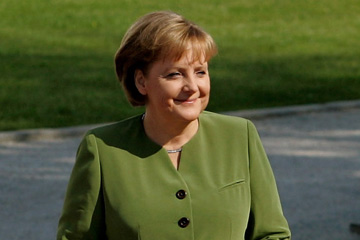
ANGELA Merkel’s grand coalition bus has been a miracle of endurance, if not a dazzling feat of German precision engineering. The engine has revved, the wheels have turned and an impressive traction gained. Indeed, the grand coalition has motored quite a way, though the passengers have seldom fully agreed on the direction.
That the coalition has pushed through the reforms that it has, and Germany’s economy has responded considerably better than most predicted, might have sparked hope that the social democrat SPD, Merkel’s partners in government, had permanently renounced its more brazen leftist tendencies. Sadly, no.
In the past 10 days Merkel’s bus has had to cope with extra bumps to add to those of soaring oil, the continuing turmoil in financial markets and the fall in the dollar. The latest threat to Germany’s continuing, if spluttering, recovery is a trenchant SPD, under its leader Kurt Beck, wishing to reassert old left credentials and start the election campaign early. Merkel seemed set to cruise to an easy victory next year; the SPD now look determined to make it a contest.
The first signs of stresses in the coalition came with the SPD annual conference in Leipzig a fortnight ago. The party has been trailing Merkel’s centre right Christian Democrats (CDU) by 10 percentage points, and Beck, whose political prospects seemed forlorn until recently, went out to raise his profile with the SPD’s traditional working class voters.
The conference saw demands for extra spending on unemployment benefits and childcare, while pledging to consider trade union demands to roll back an increase in the minimum retirement age.
Merkel, who grew up in East Germany, gave short shrift to proposals to increase unemployment benefits: “We had enough of socialism in East Germany.”
The SPD’s feisty new mood flows from a combination of the party’s poor showing in the polls – Merkel has seen her popularity rise to an unprecedented 70%-plus rating while the SPD has struggled – and Germany’s economic upswing. This has cut the jobless queues and brought unemployment down below 3.5m, the lowest figure for 13 years. Corporate profits have recovered and for 2008, Germany’s leading research institutes project a government budget surplus of 0.3% of gross domestic product (GDP) – the first such surplus since 1969. Only a few years ago the country was struggling to keep its budget deficit below the Maastricht Treaty’s ceiling of 3% of GDP.
But policy rifts have appeared in a number of areas. The parties recently clashed over coalition plans to privatise Deutsche Bahn, the state-owned railway operator. The SPD wants it to be sold off with an offer of non-voting shares to ensure government control is maintained. The CDU objects, saying this would discourage non-German strategic investors. Rows have also erupted over how to finance the extension of jobless benefits for older workers and a controversial minimum wage for postal workers.
These differences were due to be sorted out at a meeting of the coalition members last Sunday evening. Little progress appeared to be made; the parties meet again on 12 November.
Peter Struck, the SPD parliamentary group leader, estimates paying jobless benefits for up to 24 months to the older unemployed, compared with the present 18 months, will cost E800m (£557, $1,164). Meanwhile, the Federal Labour Agency reckoned the move will cost between E1bn and E2.9bn. But the CDU’s Volker Kauder has said that while agreement had been reached between the coalition members on calculating the cost, divisions on funding remain. He insists: “There can only be a cost neutral solution.”
Meanwhile, in a series of remarks unlikely to reassure overseas investors, IG Metall head Juergen Peters has declared that Germany’s biggest union is a force to be reckoned with once again and is influencing policy debate on labour issues. IG Metall represents around 3.4m workers in the metal and engineering sectors, and had felt its influence wane with the modest pay rises of recent years. But this year it has secured a 4.1% hike in Baden-Wuerttemberg and claims to have added 84,000 new members since January. “IG Metall is back,” Peters declared.
Merkel is in no mood to throw away the economic gains made this year, and is particularly opposed to conceding pay and benefit deals that would add to inflation pressures. Latest figures show preliminary consumer price inflation (CPI) data, based on results from six German states, at 0.2% on the month and 2.4% on the year. The main drivers behind this increase were food and household energy prices. It now seems unlikely that headline inflation will drop back below 2% for the remainder of the year. Indeed, there is every danger that eurozone CPI may hit 3% in the first quarter of next year. Bearing in mind the European Central Bank’s (ECB) inflation target is close to but less than 2%, this puts pressure on the ECB to raise rates from the current 4%. That is a result that would do nothing to bolster morale in Merkel’s fractious coalition bus.


